
The (Not So) Great Equalizer: Senna and Schumacher at the 1992 Spanish GP
The rainmasters vs. the car of the decade, who wins?

These two, Ayrton Senna and Michael Schumacher. They were pretty decent in the wet. Decent enough to be called rainmasters—a pretty meaningful praise, given that wet weather prowess is seen as the cream of the crop among the skills a Formula 1 driver has to have in his arsenal.
The victories of the Brazilian and the German in races such as the 1985 Belgian Grand Prix and the 2000 European Grand Prix—I purposely chose the lesser-known drives just to give them their flowers—probably contributed to the famous saying that “rain is the great equalizer.”
Some even go as far as to claim that “rain puts all cars on the same level, but not the drivers,” as Senna allegedly said. Well, he didn’t. The Brazilian never uttered such nonsense. It was an actor portraying him in the Netflix show about the late all-time great who said it.
The quote is certainly catchy and undoubtedly helps sell the story, but it’s as accurate at reflecting reality as beauty filters.
Rain can be an equalizer—sometimes even a great one—but not always. It varies. At times, it isn’t at all.
The Veteran and the Youngster
Whether you’re in Camp Senna or Camp Schumacher, you’ll likely agree that in the 1990s, no one was better than them in the wet. Of course, there were drivers versed at racing on damp tracks during the decade, such as Nigel Mansell and Jean Alesi, but none matched the highs and status of the Brazilian and German all-time greats.
In 1992, at the age of 32, Senna had both, thanks to the victories he had achieved under the banners of Lotus and McLaren during eight seasons in Formula 1. Nine years younger, Schumacher had neither. He was just an ambitious youngster trying to make a name for himself in his first full season in the sport.
The Brazilian’s wet weather prowess was already well established, while the German’s yet to be discovered. As great as they were, neither stood a chance of winning the Spanish Grand Prix—the first wet race of the season—simply because neither was driving the almighty Williams FW14B.
The Rain and the Rubber
Mansell won and even collected a grand slam: pole position, leading the race from start to finish, and setting the fastest lap. Schumacher secured the second step of the podium. Senna spun off near the end of the race from P3, on heavily worn tires.
The last part is very interesting, especially from a modern perspective, as nearly every driver in a scoring position (top 6) finished the race on the same set of wets he had started with. Alesi was the only exception. After pitting mid-race, the Frenchman, on tires that were 33 laps fresher, was up to 3 seconds faster than the leader near the end, when the conditions were at their worst.
At the start, the track was slightly damp, with barely any spray and no puddles or standing water on the surface. As the race progressed, the rain intensified, and in the closing stages, lap times were roughly 10 seconds slower than at the beginning.
The Meat and the Potatoes
The background has been established, so it’s time to focus on the crux of this post: the pace of Mansell, Schumacher, and Senna.
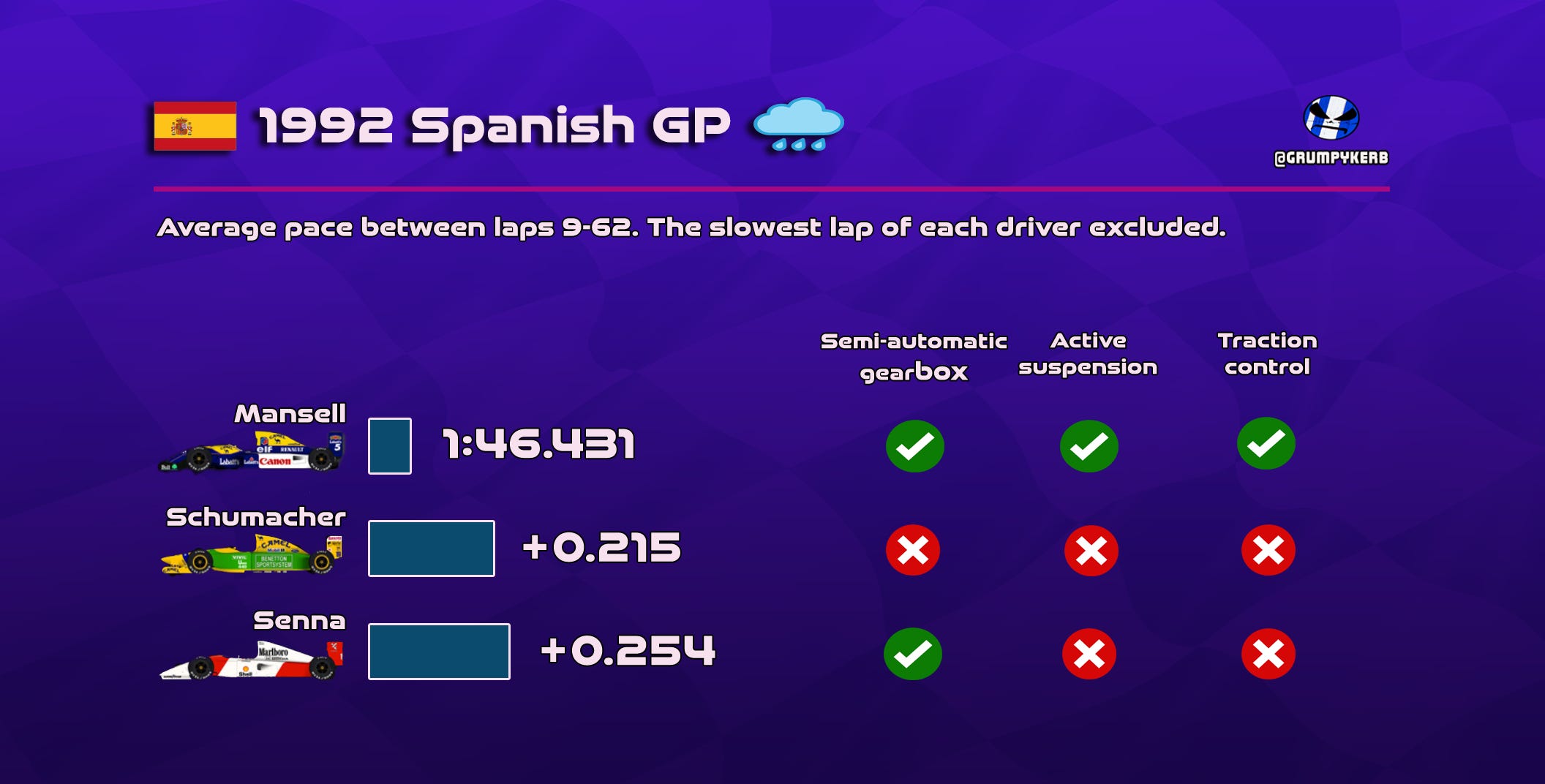
From laps 9 to 62, all three drivers drove in clean air, one behind the other, with the latter two maintaining at least a roughly 3-second gap to the car ahead.
Most of the time, that is, as they had to lap backmarkers, which is obviously more tedious in the wet, and some of the stragglers were quite uncooperative. Due to heavy traffic, the McLaren drivers briefly swapped positions, with Gerhard Berger leading his Brazilian teammate for roughly half a lap in the middle of the race.
Admittedly, the backmarkers are the main caveat of this calculation, not only because of their quantity, and the quality of their racing etiquette but also due to the locations on the track where they were caught and lapped. Obviously, catching and passing one on the main straight costs less than doing so in the middle of a corner.
Circling back to Senna, he had an off-track adventure on lap 57, losing approximately 12 seconds. As you might expect, this affected the Brazilian’s average pace and his gap relative to Mansell during the stint. Including the feral lap, the gap increased to 0.407 from 0.254 seconds.
That’s why I excluded it and also removed the slowest laps of the other two drivers to maintain consistency. I believe this approach is more representative.
The Guilty Italian
In general, the pace of the German and the Brazilian didn’t look bad, as they were roughly within 0.250 seconds of the vastly superior car, which was equipped with active suspension and traction control.
Indeed, they had neither system, but they drove new cars. The Benetton B192 had its baptism of fire in the race in question, and the McLaren MP4/7A, the first to feature a semi-automatic gearbox, had debuted in Brazil. On the other hand, the almighty FW14B had been racing since the season opener at Kyalami.
Although the new cars driven by Senna and Schumacher were inferior, they were still an improvement over the 1991 machinery, with which both drivers began the 1992 season.
Speaking about the Williams’ hegemony, the flattering gaps within 0.250 seconds, dilute it quite a bit. If there is anyone to blame for that, it’s Mansell’s teammate, Ricardo Patrese.
Should I Push or Should I Cruise
Before crashing out of the race on lap 20, the Italian held second place and kept the Brit honest, forcing the leader to push. Now, observe the pace of the Mansell-Schumacher-Senna trio when the Williams driver had an incentive to go flat out.
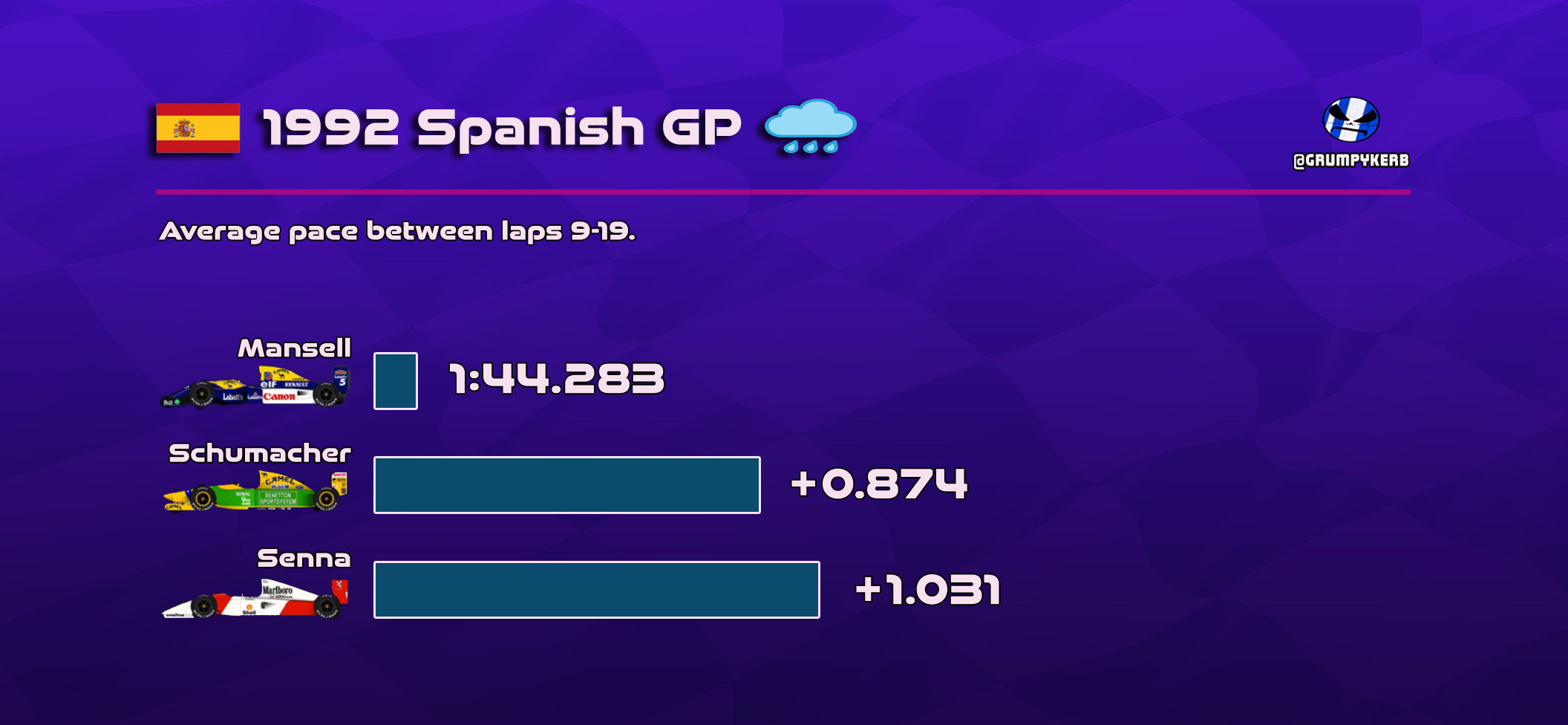
Far less flattering, isn’t it?
How was Patrese faring during those 11 laps? Very well—he was only 0.026 seconds off his teammate’s pace and at least 0.8 seconds ahead of the Benetton-McLaren duo.
Deprived of any incentive to push, Mansell took it relatively easy for most of the stint. At the end of lap 19, the Brit held a 23.041-second lead over Schumacher. 31 tours later, the German had closed the gap to 4.492 seconds. Interestingly, both Schumacher and Senna were respectively 0.598 and 0.528 seconds faster than Mansell during those 31 laps.
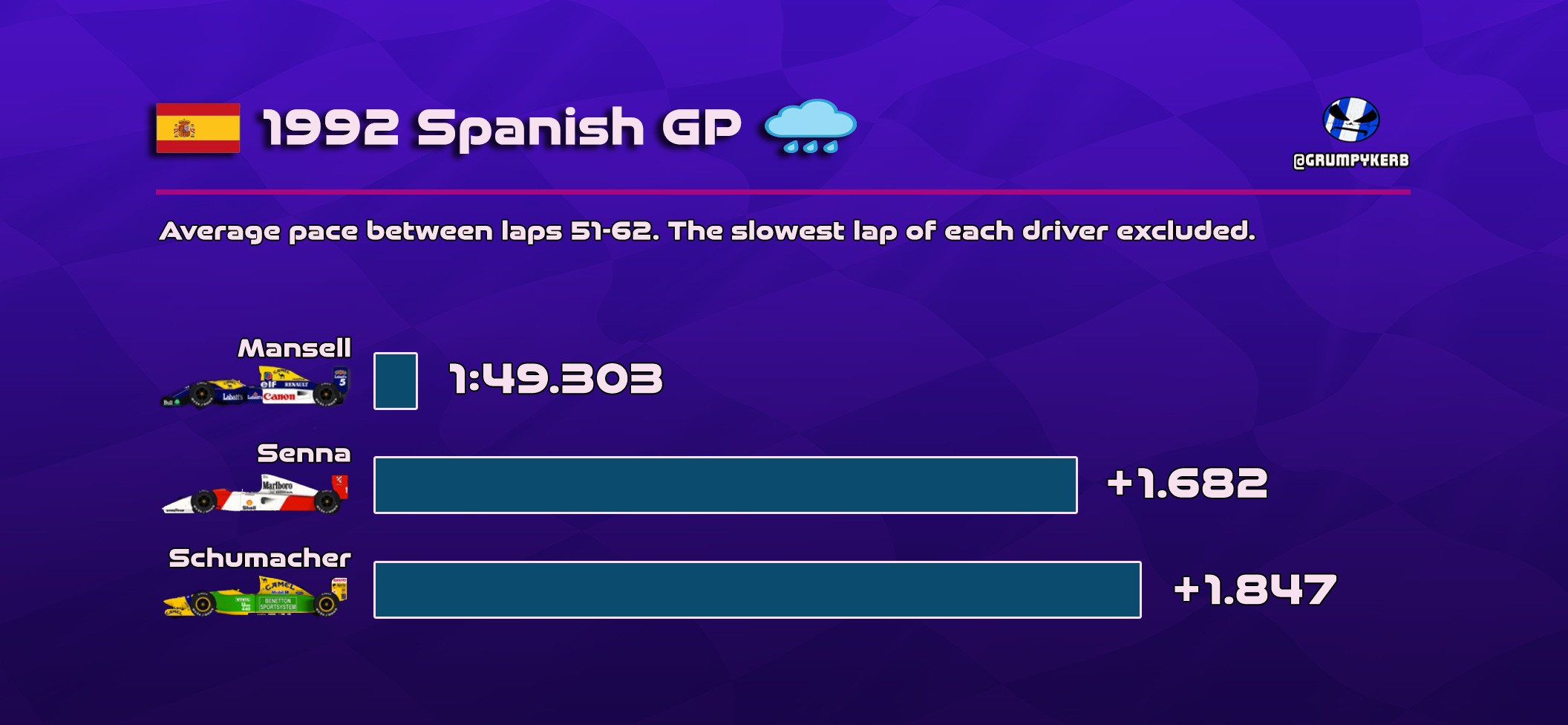
Then the leader woke up and picked up the pace. The German tried to keep up with him, but by lap 58, he was 13.384 seconds behind Mansell.
Schumacher likely realized that winning his first race was out of reach, so he switched to cruise mode and settled for P2. From lap 59 onward, the German’s lap times dropped by roughly 5 seconds.
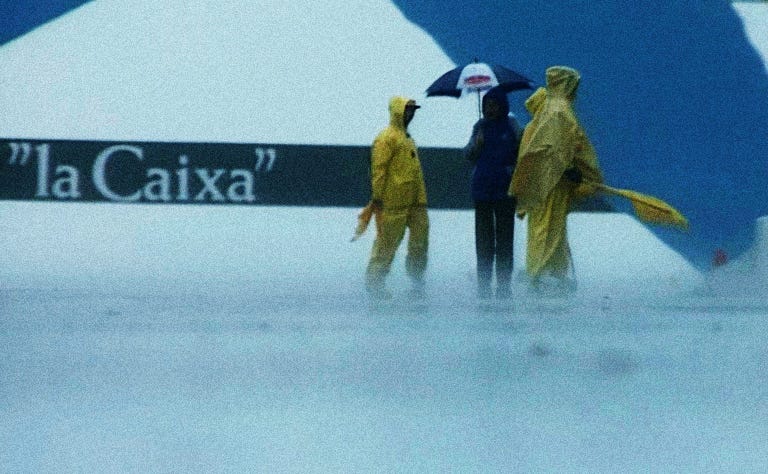
The Williams driver increased the pace as the rain intensified. It was pouring heavily. The sky was supplying more of the equalizer, but it did not benefit the rainmasters. In fact, it had the opposite effect.
The Devil Is in the Details
If you want to argue with me, you might point out that Schumacher won the Belgian Grand Prix, held in mixed conditions, later in the season. I’m well aware of that race, having once written an overly long post about it. The German won thanks to three factors: switching to slicks before the Williams drivers, blistering pace out of the pits, and a stroke of luck when Mansell encountered engine issues.

What about Senna? After all, he beat the FW14B’s successor at Donington and Suzuka the following year. In 1993, the Brazilian drove a car also equipped with active suspension and traction control. Without these driving aids, he would’ve barely stood a chance.
Plus, at the 1993 European Grand Prix, the Brazilian was helped by Williams running their cars too low, hence they “were aquaplaning, not so much on the tires, but on the large flat bottom of the undertray.”
Now, does that take away anything from Senna’s and Schumacher’s victories? No. It only does if you believe that rain literally equalizes the field. But then, consequently, you would have to believe that, before crashing, Patrese was outperforming both acknowledged rainmasters in the wet 1992 race in Barcelona.
This entire post is not intended to devalue wet weather prowess, but to put things into perspective. In the rain, the driver can make a bigger difference than in the dry. It’s somewhat like Monaco, where individual bravery and skill matter more than, say, Bahrain—at least in qualifying. However, the car still needs to be relatively competitive to take pole.