
Back to V8s
Looks like the current power units will have a relatively short run in Formula 1. They could be replaced by eight-cylinder naturally aspirated engines as early as 2030.

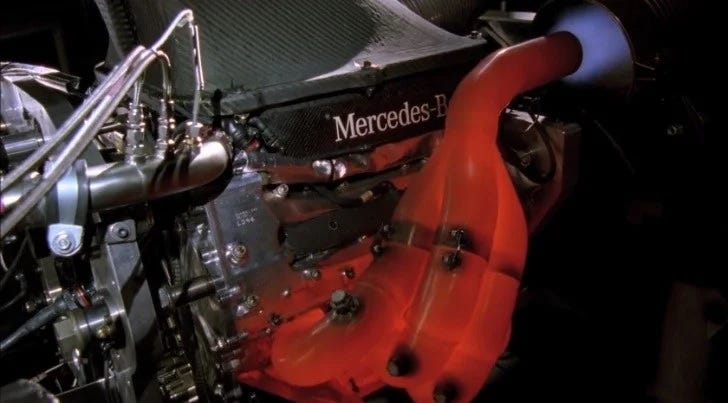
There is hope—a bright, glowing like a full moon light, at the end of a dark tunnel. FIA president Mohammed Ben Sulayem recently revealed a plan for new power unit regulations that could come into force in 2030. V8 engines paired with small batteries are on the agenda. According to the Emirati himself, it’s only a matter of when, not if.
It’s coming. At the end of the day, it’s a matter of time. In 2031, the V8, the FIA will have the power to do it, without any votes from the PUMs (Power Unit Manufacturers). That’s the regulations. But we want to bring it one year earlier, which everyone now is asking for.
The idea of fast-tracking the V8s is not new. Ben Sulayem attempted to do so last year, but the president’s initiative met no enthusiasm from manufacturers. After being put on hold, the proposal has now returned, when the timing and environment are much more favorable. Simply put, given the backlash against the 2026 regulations, manufacturers are less likely to dig their heels in.
Back to the Good Old Days?
Ben Sulayem isn’t the sole pole bearer of the idea. Formula One Group CEO Stefano Domenicali had expressed support for the V8s, before the FIA president attempted to fast-track the return of naturally aspirated eight-cylinder engines. If the views of the governing body and the commercial rights owner are aligning, that’s good for the views. They’re much more likely to materialize.
The V8s and small batteries? That rings a bell. Oh, we actually had that in Formula 1, partially in 2009 and more extensively between 2011 and 2013. The cars were powered by the aforementioned engines paired with the MGU-K—although it was called KERS at the time—in roughly a 90/10 power split. In a way, the sport is coming full circle. Back to the good old days.
The three-year period gave us the 2011 Canadian Grand Prix, widely regarded as the best race of the 2010s; arguably the best single-season performance of the decade by Fernando Alonso in 2012—the best season of the decade—another gift from the time.
Since it was so good, why did it end so relatively quickly? Manufacturers wanted the power units to be more road-relevant.
My Interests First
Manufacturers are no different than Formula 1 teams: first and foremost, they care and act upon what’s best for them. Some are already trying to strike the iron while it’s hot. Toto Wolff said that Mercedes is onboard with the return of V8s, but not necessarily with drastically reducing the electrical component.
We need to consider that, make it simpler and make it a mega engine. Maybe we can extract 800bhp off the ICE [engine] and we put 400bhp on top of it—or more, in terms of electric energy.
So the Austrian has proposed a 70/30 split. I wish him nothing but failure, but I understand that he’s doing what he’s paid for. For over a decade, manufacturers have been having more power and influence in the sport than they have ever had. Only a fool wouldn’t capitalize on it.
Growing in Strength
Historically, Formula 1 was a privateer endeavor. Those days are long gone now, though. There have always been factory teams, with Ferrari being the prime example, but the core of the sport consisted of rich guys who put their hearts and money into racing. These are the roots of McLaren and Williams.
In the 1980s and 1990s, the former won championships with Porsche and Honda, while the latter with Ford, Honda, and Renault. McLaren also triumphed with Mercedes during the aforementioned period, but with the German manufacturer they had similar partnership to the one between Red Bull and Honda in recent years. They operated as a works team in all but name.
Since their first championship as McLaren Mercedes in 1998, the only customer teams to win either of the titles have been Brawn GP in 2009, Red Bull from 2010 to 2013, and, ironically, McLaren in the last two years.
Ironically, because their 2024 and 2025 chassis were powered by Mercedes engines, and because the team with Ron Dennis at the helm had pioneered the close ties with a major manufacturer, which they no longer have. Now they’re just a customer. The only one among the top runners.
A Reversal?
The political influence of manufacturers has grown over time. Obviously, without them, F1 couldn’t exist and, in the early 2010s, they were no longer interested in simply building engines according to the rules written by the FIA. They have molded the rules themselves. The 2014 regulations were the first real step in the direction of sustainability and road relevance, which have been manufacturers’ mantra.
The 2026 ones were aimed at bringing more of that to attract more of them. Honda came back. Audi joined. Together with Mercedes, Ferrari, and Red Bull, who took on the task of making their own engines, they complete the five manufacturers. Could’ve been six, but Renault stopped producing power units for their works team Alpine, which became a Mercedes customer.
So the rules achieved their goal. No doubt about it. However, the question of how good they turned up to be for racing, has a lot of them. The recent tweaks, which, according to Lando Norris, are not good enough, just as the willingness to ditch the 50/50 split for 2027, are only adding credibility to them. Just like those who think the governing body has catered to manufacturers too much in the past fifteen years, I would argue.
If Ben Sulayem is right, if the FIA can simply force the V8s with minimal electrification—whatever that means—in 2031, then manufacturers, at least for a few years, will have to just do as they are told, like in the good old days.